
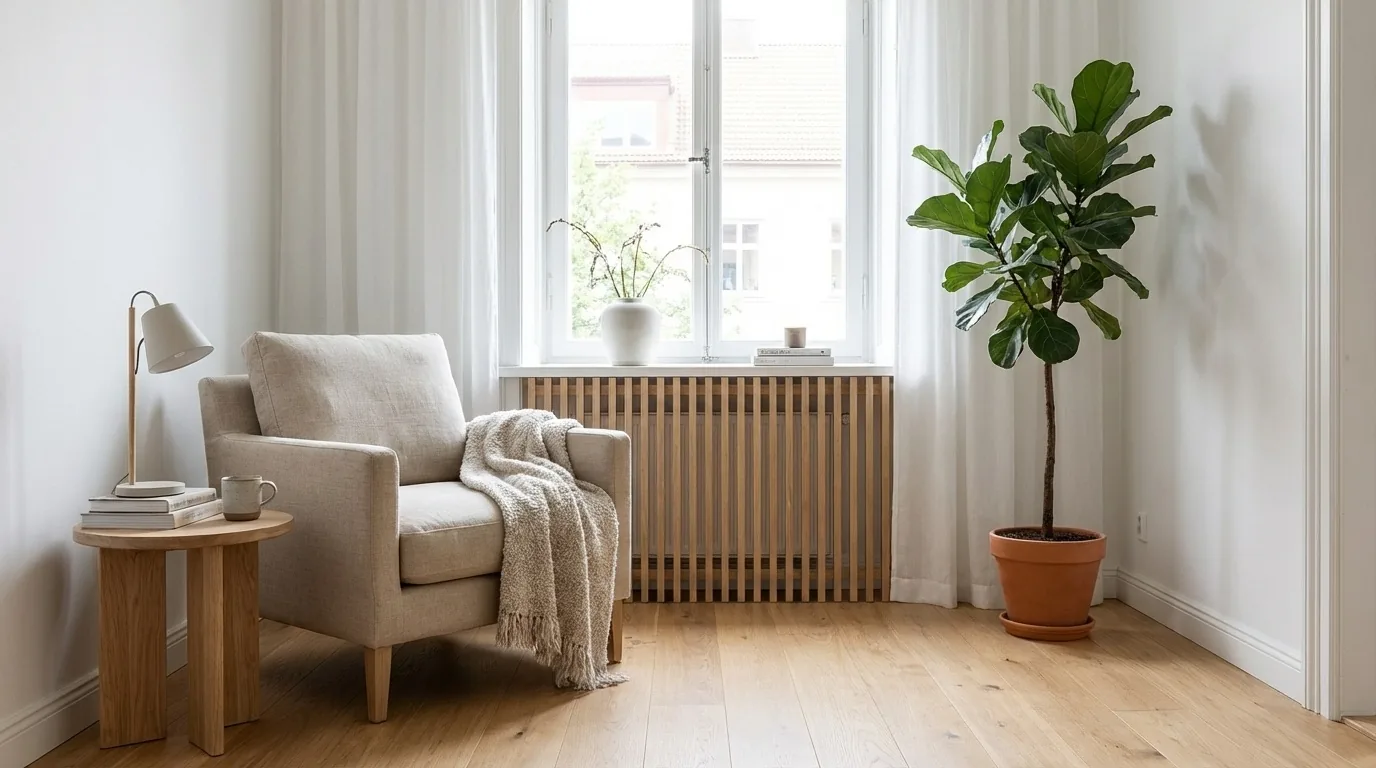
Anyone living in a late-19th-century apartment knows them: the cast iron heavyweights with decorative ribs, the heavy column radiators, the old tubular radiators in the bathroom. They have heated reliably for almost 100 years — and still disrupt the look of every second renovation concept.
The obvious idea: cover them. What takes 15 minutes with a modern panel radiator becomes more complicated with period radiators. In 17 years as a workshop we have made many bespoke covers for cast iron radiators. Here is what we have learned.
The three most common period radiator types
1. Cast iron radiators (approx. 1880–1950)
The classics: heavy, decorative, often adorned with columns or ribs. They were installed between roughly 1880 and 1950 in almost every German period building. Typical dimensions:
- Height: 50–110 cm
- Depth: 18–26 cm (much deeper than modern radiators)
- Width: 40–200 cm, in 5–10 cm steps depending on the number of sections
- Weight: 30–120 kg — moving them is rarely an option
2. Column radiators (cast steel, approx. 1920–1970)
The successors of cast iron radiators. Slimmer columns, smooth surface, often two or three columns side by side. Typical dimensions:
- Height: 60–80 cm
- Depth: 10–22 cm
- Width: 60–200 cm
3. Tubular radiators (steel, all eras)
Vertical or horizontal steel tubes. Often used as towel radiators in period bathrooms, less common in living rooms.
- Height: highly variable (50–180 cm)
- Depth: 10–18 cm
- Function: often combined with towel drying
Why standard-size covers usually don't fit
Look at the dimensions above and compare them with what you find in furniture stores or online shops:
| Cover type | Usual depth | Fits a cast iron radiator? |
|---|---|---|
| Discount MDF box | 8–12 cm | No (too shallow) |
| Furniture-store radiator cover | 10–15 cm | Rarely — it pinches |
| Standard solid-wood radiator cover | 18 cm | Tight — works for flat columns |
| Bespoke workshop cover | 18–35 cm | Always fits — if measured correctly |
That is the core of the problem: cast iron radiators are too individual in depth to be covered off the shelf. If you want to hide them, you have to measure — precisely.
What does NOT work with cast iron radiators
❌ A closed box with a door
A classic from online furniture retail. Already problematic with a normal panel radiator (15–30 % heat loss), catastrophic with cast iron: the cover has to be so deep that a dead air pocket forms inside. The radiator then mainly heats the inside of the box.
❌ A fully built-over cover used as a "bench"
Very popular on Pinterest, usually poor in reality: a bench top 5 cm above the radiator blocks convection completely. The room stays cold, the heating system compensates — and the extra energy quickly adds up to 15–25 % a year.
❌ Hiding it behind a curtain or furniture
For the detailed discussion see our article "7 ways to hide a radiator" — in short: a curtain loses 30–50 % of the heat output, furniture in front of it even more.
What works: a bespoke cover with an open slatted design
An open slatted cover respects the two non-negotiable requirements of a period radiator:
- Enough depth so the cover fits completely in front of the radiator — without pressure on the valves, without pinching the connecting pipes
- Free convection so warm air can rise between the slats and the heat output is retained
Our open slatted covers in solid oak are designed for exactly this. Vertical 18 mm slats at a precise spacing, no visible screws, completely open at the front for thermostat access. Up to 96 % of the original heat output is retained.
How we measure cast iron radiators correctly
Before you open the configurator, we need three measurements — precise, with a folding rule or laser measure.
Width (W)
From the outermost left point of the radiator (valve, column, connection) to the outermost right point. Plus 3–5 cm clearance on each side for connections and thermostat operation.
Height (H)
From the floor (or skirting board) to 5–10 cm above the top edge of the radiator. If you want a shelf on top, allow at least 5 cm for it.
Depth (D)
The decisive measurement for period radiators. From the wall to the front edge of the radiator. Plus 4–6 cm buffer for the slats, free air circulation and fitting tolerance.
Unsure about measuring?
Send us a photo of your radiator to [email protected] — we reply with the right measurements within 24 hours. Free of charge.
Three typical cases from the workshop
Case 1: Column radiator in a period apartment
- Radiator: 90 × 60 × 18 cm column radiator, original from the 1920s
- Cover: bespoke 100 × 70 × 24 cm in natural oak
- Price: €339
- Assembly: 20 minutes, no tools
Case 2: Cast iron radiator in a bathroom
- Radiator: 70 × 80 × 22 cm ribbed cast iron radiator, early 1900s
- Cover: 80 × 95 × 28 cm in smoked oak
- Price: €469
- Special feature: cut-out for a side-mounted thermostat
Case 3: Tubular radiator in a living room
- Radiator: 140 × 70 × 12 cm steel tubes, 1960s
- Cover: standard size Hamburg (140 × 65 × 20 cm), fitted exactly
- Price: €399 (standard price)
- Lesson: tubular radiators often fit our standard sizes — measuring first pays off.
When a cover is NOT the right solution
- Bathroom towel radiators: you need the towel function. A cover kills it.
- Rented flats you will leave soon: with less than a year left, the investment rarely pays off.
- Very small bathroom radiators under 50 cm: a solid oak cover often overwhelms a tiny room. Painting is usually the better choice here.
- Listed buildings: in rare cases cast iron radiators are protected as part of the heritage listing. Ask the heritage office first.
Frequently asked questions
Can a cast iron radiator be covered at all?
Yes — but only with an open slatted construction, made to measure. Standard sizes usually don't fit because cast iron radiators are much deeper than modern ones.
How deep are cast iron radiators typically?
18–26 cm for classic models from 1880–1950. Heavy column radiators from the 1920s can be up to 30 cm deep. Measuring first is essential.
What does a bespoke cover for a cast iron radiator cost?
At BRANDSTIFTER a bespoke cover starts at €229. For deeper cast iron radiators the depth surcharge is shown transparently in the configurator. Typical range: €280–550.
Does the radiator have to be removed?
No. Our covers are built around the existing radiator. You place them in front of it. No plumber, no draining the system.
Do I lose heat output?
With an open slatted cover in solid oak, up to 96 % is retained. With closed MDF covers 20–40 % — the combination of a sealed box and a deep radiator is particularly unfavourable.
Related articles: Redesigning period radiators · How to measure a radiator · The heat-loss myth